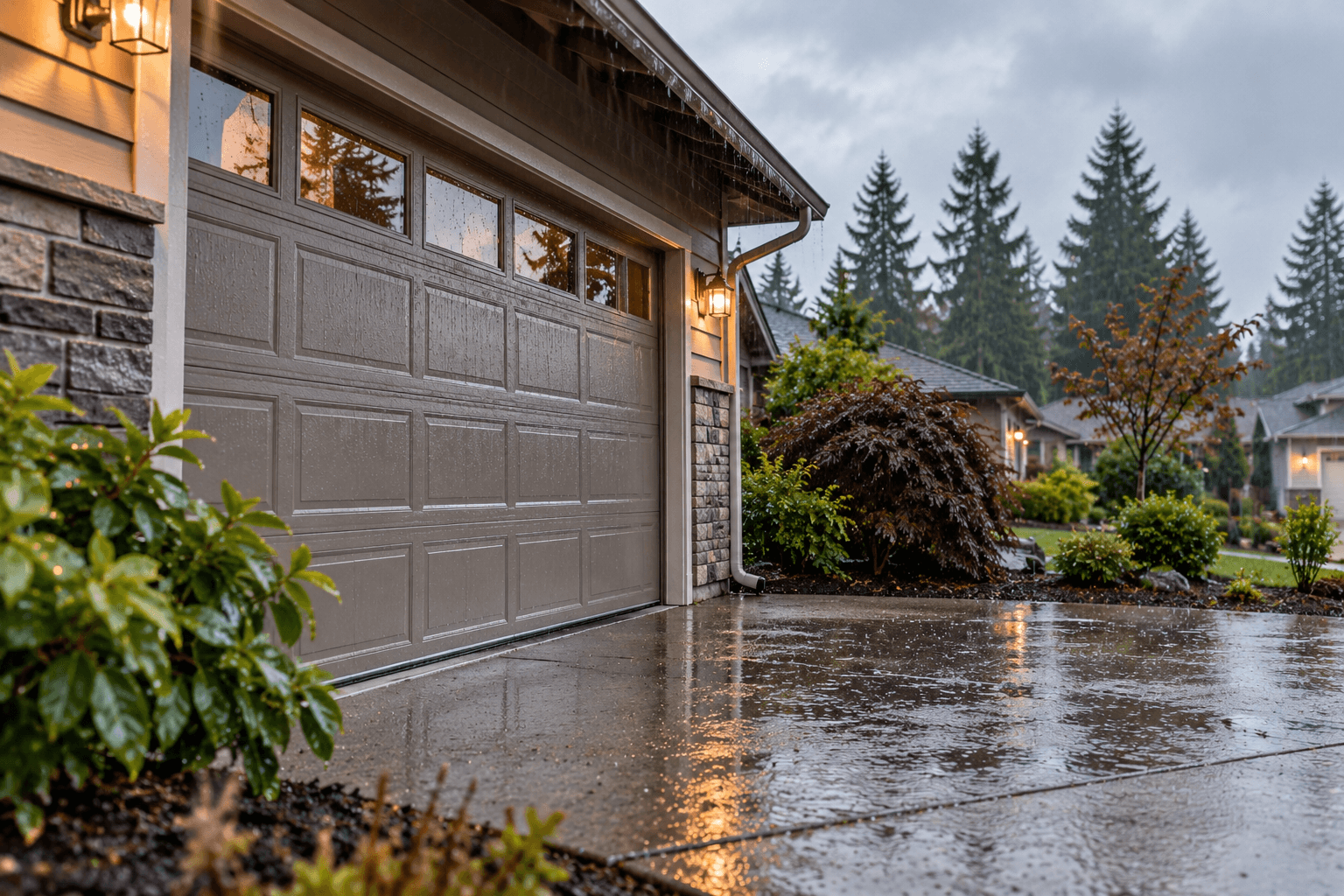
Puyallup homeowners know that rain is part of life in the South Sound. The wet season can put more water around your driveway, garage entrance, roof drainage, and the exterior hardware of your garage door.
That doesn’t mean rain automatically damages a garage door. A properly installed and maintained door is designed to handle normal outdoor conditions. The bigger concern is what happens when moisture repeatedly reaches metal components, deteriorates weather seals, or collects around the garage opening.
Puyallup also has documented stormwater and drainage challenges. The City of Puyallup notes that stormwater comes from rainfall and runoff from roofs, driveways, sidewalks, roads, and other surfaces. The city has also identified locations where drainage capacity can contribute to flooding during moderate and large rain events.
For your garage door, that makes it worth paying attention to where water is coming from, where it collects, and whether the door and its hardware are showing signs of wear.
What Does Wet Weather Actually Do to a Garage Door?
The effect of rain isn’t usually one dramatic event. More often, problems develop gradually.
Garage doors contain numerous metal components, including springs, hinges, brackets, tracks, fasteners, and other hardware. Repeated exposure to moisture can contribute to corrosion, particularly when water remains on or around a component instead of draining away.
The same principle applies to moving parts. Corrosion or accumulated grime can affect how smoothly components move, although moisture isn’t necessarily the only reason a garage door becomes noisy, stiff, or difficult to operate.
That’s an important distinction. A rusty component doesn’t automatically mean rain caused the failure. Springs have a finite operating life, rollers wear out, cables can deteriorate, and openers eventually develop mechanical or electrical problems. Wet weather can be one contributing factor rather than the sole cause.
Garage Door Springs and Moisture
Garage door springs carry a substantial portion of the door’s weight. Because they’re under high tension and are constantly working whenever the door opens and closes, they deserve particular attention when signs of corrosion appear.
Surface rust doesn’t necessarily mean a spring is about to break. But significant corrosion, unusual spring behavior, or a garage door that suddenly feels extremely heavy are reasons to have the system inspected.
Never try to adjust, remove, or replace a torsion or extension spring yourself. Garage door springs store considerable energy, and improper handling can cause serious injury.
If a spring breaks, the door may become extremely heavy or fail to open normally. That’s a mechanical problem that should be handled by a qualified garage-door professional rather than forced open repeatedly.
Rollers, Hinges, Tracks and Other Hardware
Moisture can also affect the smaller components that allow a garage door to move.
Rollers, hinges, brackets and fasteners are exposed to the garage environment every day. When corrosion or wear begins affecting those components, homeowners may notice changes before anything actually fails.
You might hear more squeaking or grinding. The door might feel less smooth while opening. It may shake or hesitate in one section of its travel.
Those symptoms aren’t proof that moisture is responsible. A worn roller, damaged hinge, track problem, loose hardware, or another mechanical issue can produce similar symptoms.
That’s why it’s better to look at the whole door system rather than replacing whichever component looks rusty first.
Water Coming Under Your Garage Door? Don’t Blame the Seal Too Quickly
This is one of the most important things for Puyallup homeowners to understand.
If rainwater is getting underneath a closed garage door, the first assumption is often that the bottom weather seal needs to be replaced.
Sometimes it does.
But not always.
Homeowners discussing this problem on home-maintenance forums frequently run into the same issue: the door seal may be in reasonable condition while the driveway, concrete apron, or garage floor directs water toward the door. In those situations, installing a new seal may improve the situation without actually solving the underlying drainage problem.
A garage door’s bottom seal helps close the gap between the door and the floor. It isn’t a waterproof flood barrier.
If rainwater is already pooling against the garage opening, the water has nowhere to go. Wind-driven rain can make the situation worse by pushing water against the door and its seals.
Before replacing parts, look at what happens outside the garage during heavy rain.
- Does water naturally flow away from the door?
- Does it collect against the threshold?
- Is there a low spot in the driveway or concrete apron?
- Does water come through one particular section or corner?
Those observations can tell you much more than simply looking at the rubber seal.
Check the Weather Seal for Wear
The bottom seal is still an important part of the garage door system.
Over time, rubber seals can become hard, cracked, compressed, or otherwise unable to make consistent contact with the floor. If you can see obvious gaps when the door is closed, or the seal no longer conforms to the surface beneath the door, it may be time for replacement.
Side and top weatherstripping should also be checked.
But don’t automatically assume a thicker seal will solve every water problem. If the surface beneath the door is uneven or slopes toward the garage, the underlying drainage issue may need to be addressed as well.
This distinction is important when diagnosing water intrusion around a garage. Replacing a worn seal makes sense when the seal is actually deteriorated, but it won’t correct a drainage or grading problem outside the garage.
Puyallup’s Rain Can Also Expose Drainage Problems Around the Garage
Sometimes the garage door isn’t the source of the problem at all.
The City of Puyallup explains that stormwater includes runoff from rooftops, lawns, sidewalks, roads and other surfaces. That water has to be directed somewhere.
If water from the roof or driveway is being directed toward your garage opening, even a good door seal can eventually be overwhelmed.
This is particularly important after a heavy storm. Instead of immediately buying replacement parts, watch where the water travels.
A simple inspection can answer several useful questions:
- Is water pooling directly outside the garage?
- Is runoff coming from a downspout?
- Does the driveway or concrete apron slope toward the door?
- Is water entering evenly across the opening or only at one side?
- Is the bottom seal cracked, hardened, or visibly damaged?
If the problem is clearly related to grading or drainage, a garage-door repair alone may not be the complete solution.
How Puyallup Homeowners Can Reduce Weather-Related Wear
You don’t need to dismantle your garage door to protect it from wet weather.
Start with regular visual inspections. Look for obvious corrosion, damaged seals, unusual gaps, loose-looking hardware, or changes in how the door moves.
Keep leaves, dirt and other debris from accumulating around drainage areas near the garage. Puyallup’s flood-preparedness guidance also recommends keeping gutters, downspouts and storm drains clear to help reduce localized flooding.
It’s also worth paying attention to the door after particularly wet periods. If it suddenly becomes noisy, uneven, difficult to lift, or doesn’t close properly, don’t assume that the problem will disappear once the weather improves.
And be careful with DIY adjustments.
Garage door springs, cables and other counterbalance components are not good homeowner DIY projects. If one of these components is damaged or has failed, have the system inspected rather than trying to compensate by adjusting the spring or forcing the door to operate.
When Should You Have Your Garage Door Inspected?
A little surface rust or an aging weather seal isn’t necessarily an emergency.
However, some symptoms deserve professional attention, particularly when they affect the door’s movement or safety.
Have the door inspected if you notice:
- The door suddenly feels much heavier than usual.
- A spring or cable appears damaged.
- The door is crooked or uneven when opening.
- A roller or hinge is visibly damaged.
- The door comes off its tracks.
- The opener struggles to move the door.
- Water is repeatedly entering despite an apparently good seal.
- The door makes a new grinding, scraping, or unusually loud noise.
The important thing is to address the underlying problem rather than simply replacing the most visible part.
A Little Maintenance Can Prevent Bigger Garage Door Problems
Puyallup’s wet weather isn’t something you can prevent, but you can pay attention to how your garage door responds to it.
Keep an eye on the weather seals. Watch for corrosion and changes in door movement. Make sure water isn’t collecting against the garage entrance. Keep nearby drainage paths clear. And if something suddenly changes, have it checked before a relatively small problem turns into a door that won’t open when you need it.
For homeowners who want the entire system checked, professional garage door maintenance can identify worn or damaged components before they become an unexpected repair. Our garage door maintenance and tune-up service is available for homeowners in Puyallup and nearby communities.
Frequently Asked Questions
Can rain damage a garage door?
Normal rain shouldn’t damage a properly maintained garage door by itself. Repeated moisture exposure can contribute to corrosion and deterioration of exposed components and seals, while heavy or wind-driven rain can expose drainage and water-infiltration problems around the garage opening.
Why does water come under my garage door when it rains?
The bottom seal may be worn or damaged, but it isn’t always the cause. Water can also be directed toward the garage by the driveway, concrete apron, garage floor, roof runoff, or other drainage problems.
Should I replace my garage-door seal if water is getting inside?
Possibly, but inspect the area first. If the seal is cracked, hardened, damaged, or leaving visible gaps, replacement may help. If water is pooling against the door because of the surrounding concrete or drainage, replacing the seal alone may not solve the problem.
How often should I check my garage door?
A quick visual check every few months—and especially after periods of heavy weather—is reasonable. Pay attention to changes in noise, movement, balance, visible corrosion, damaged seals, and water around the opening. A professional inspection is appropriate when you notice a mechanical or safety-related change.
Final Thoughts
Rain itself isn’t necessarily the enemy of your garage door. Unnoticed wear, standing water, poor drainage, deteriorated seals, and neglected hardware are where problems can develop.
If water is getting into your garage, start by finding out where it is coming from. If the door is showing mechanical symptoms at the same time, don’t assume the rain is the entire explanation.
A good diagnosis looks at the door, the seal, the garage floor, and the drainage around the opening together.